Slot Machine Industry Trends Worth Watching
The slot machine industry has historically served as the financial backbone of both land-based casinos and digital iGaming platforms. For decades, the fundamental mechanics of a slot machine remained relatively static: a player inserted capital, spun the reels, and relied entirely on a localized random number generator to determine the financial outcome. While visual elements transitioned from mechanical gears to digital video screens, the core gameplay loop altered very little.
However, the rapid convergence of advanced hardware, machine learning, and shifting consumer demographics has initiated a profound wave of modernization. Today, slot machine manufacturers and casino operators are navigating a highly competitive entertainment market where slots do not merely compete against other casino games, but also against mainstream console video games, social media feeds, and streaming media services. To capture and sustain the attention of modern consumers, the industry is embracing radical technological innovations that are permanently altering how slot games look, feel, and function.
Artificial Intelligence and Dynamic Personalization
The integration of artificial intelligence and machine learning represents one of the most disruptive trends sweeping through modern slot design. Historically, every player who sat down at a specific slot machine cabinet experienced the exact same mathematical volatility, game speed, and bonus frequency, regardless of their personal playing style or behavioral preferences.
Modern slot machines utilize advanced AI-driven player analytics to create hyper-personalized experiences in real time. When a user logs into a cabinet using a loyalty card or a digital wallet app, the system scans their historical gameplay metrics. As the session progresses, machine learning algorithms analyze real-time variables, including the speed of individual spins, betting adjustments, and the user physiological response to wins or losses.
Using this data, the software can dynamically alter game characteristics within pre-approved regulatory boundaries. For example, if the AI detects that a player enjoys extended playtime with low risk, it can automatically adjust the visual delivery of low-volatility bonus triggers to increase session duration. Conversely, if a player exhibits a preference for high-stakes, rapid-fire action, the platform can streamline visual animations and shift the player options toward high-volatility betting paths. This micro-customization significantly enhances player satisfaction by optimizing the entertainment delivery to match individual cognitive preferences.
The Rise of Skill-Based and Hybrid Gaming Mechanics
For generations, slot machines appealed primarily to traditional demographics who embraced pure games of chance. However, millennial and Generation Z consumers, raised on interactive video games and tactical mobile apps, often find traditional slot machines unengaging due to the total lack of player agency. To bridge this generational divide, manufacturers are investing heavily in skill-based and hybrid slot mechanics.
Unlike traditional formats where the final outcome is entirely random, skill-based slots feature interactive bonus rounds where a player cognitive dexterity, timing, or hand-eye coordination directly influences the payout size. Instead of simply watching a wheel spin during a bonus trigger, a player might navigate a digital spaceship through an asteroid field using a joystick built into the cabinet armrest, or solve a rapid puzzle on a secondary touchscreen display.
While the baseline math engine preserves a minimum return-to-player threshold mandated by law, the elite tier of payouts is reserved for players who perform exceptionally well during these interactive challenges. This hybrid format successfully shifts the psychology of the slot floor, transforming the experience from a passive observer sport into an active, competitive gaming arena.
Immersive Hardware Engineering and Cinematic Cabinets
As traditional high-definition curved displays and spatial audio setups become standard consumer electronic features in the home, slot manufacturers are forced to scale up their hardware engineering to deliver experiences that cannot be replicated on a standard living room television or smartphone.
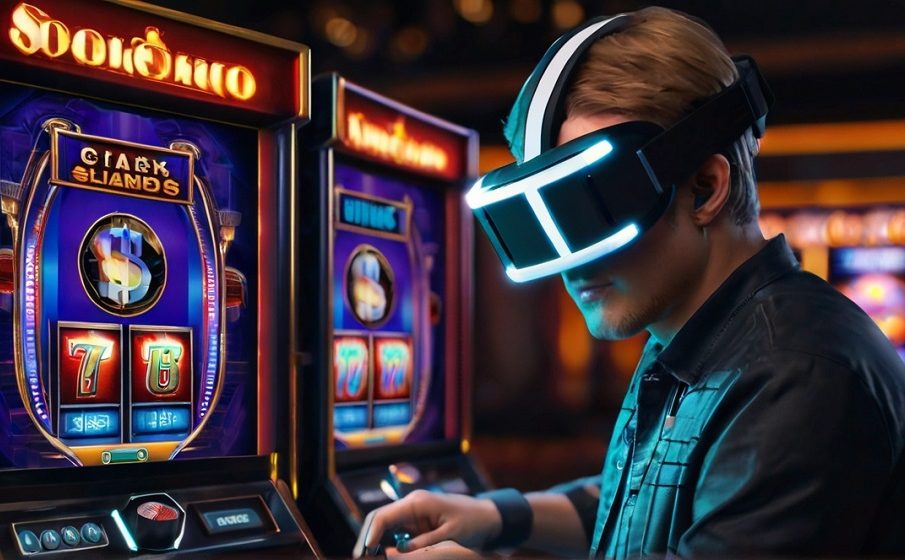
The modern slot floor is increasingly populated by massive, ergonomic cinematic cabinets that wrap entirely around the player field of vision. These high-tech structures feature ultra-high-definition 4K and 8K OLED curved displays, advanced holographic projection overlays, and directional sensory audio systems embedded directly into the headrest upholstery.
Furthermore, operators are implementing complex haptic feedback chairs that synchronize physical movement with on-screen visual triggers. If a player hits a major winning combination that features a volcanic eruption animation, the seat vibrates with sub-bass frequencies, while the ambient LED lighting across the entire bank of machines shifts colors in perfect harmony. This sensory synchronization creates an enveloping, theme-park-style atmosphere that maximizes the psychological reward loop of the game.
Blockchain Transparency and Provably Fair Technology
In the rapidly growing digital slot sector, maintaining consumer trust regarding software integrity is paramount. While traditional platforms rely on closed-box random number generators that are verified by independent external testing laboratories, a growing segment of modern players demands immediate, verifiable mathematical transparency.
To meet this demand, digital slot developers are actively implementing blockchain architecture and provably fair technology. When a player spins a blockchain-integrated slot game, the exact randomness of the spin is determined by a public cryptographic hash function rather than an unviewable internal script.
The player is provided with a unique digital token that allows them to verify the absolute randomness of that specific spin on a public ledger instantly. This decentralization completely eliminates any skepticism regarding backend game manipulation or hidden house biases. Furthermore, the integration of smart contracts allows for instantaneous, decentralized jackpot distributions directly into player digital wallets, erasing the traditional multi-day clearance delays associated with legacy banking networks.
Platform Convergence and Omnichannel Loyalty Ecosystems
Historically, a player physical casino experience and their online gaming activity operated as two entirely separate entities. A consumer could spend hundreds of dollars on a physical slot machine over a weekend and receive zero recognition or rewards when playing on that same casino brand mobile application at home during the week.
The modern industry is aggressively eradicating this operational friction through platform convergence and the construction of omnichannel loyalty ecosystems. Using cloud-based server-based gaming infrastructure, slot titles are developed simultaneously for land-based cabinets, desktop web browsers, and mobile applications.
A player can initiate a progressive jackpot narrative quest on a physical machine in a Las Vegas resort, save their progress directly to their mobile account via a biometric smartphone scan, and resume the exact same storyline with identical accumulated multipliers on a mobile device while transit lounge at an airport. This unified ecosystem ensures that a player lifetime value is tracked holistically across all digital and physical channels, allowing operators to deploy synchronized rewards and personalized incentives that sustain customer engagement far beyond the boundaries of the physical casino floor.
Frequently Asked Questions
What is the purpose of a replacement cycle on a modern casino floor?
A replacement cycle refers to the strategic operational practice where a casino floor manager systematically replaces fifteen to twenty percent of their physical slot machine cabinets annually. This practice is vital for maintaining high floor performance, as newer machines equipped with advanced graphics, touchscreens, and modern themes consistently demonstrate higher time-on-device metrics and greater overall revenue generation compared to older, fading hardware setups.
Do skill-based slot machines violate state regulations requiring games of chance?
No, skill-based slot machines are engineered to comply fully with state gaming regulations. The underlying regulatory compromise dictates that the game must always guarantee a baseline return-to-player percentage based purely on chance, ensuring that even a player with zero physical coordination will eventually win a legally mandated minimum. The skill element simply introduces a variable overlay that allows highly proficient players to unlock premium bonus tiers, adding an adjustable mathematical layer on top of the random foundation.
What is provably fair technology in modern slot game development?
Provably fair technology is a cryptographic algorithm protocol that utilizes open-source blockchain hashing functions to determine game outcomes. Before a spin occurs, the server generates a seed value, and the player device generates a separate seed value. These two data strings are combined to calculate the final spin position. Because the math is verified on a decentralized public ledger, the player can verify manually that the outcome was completely unmanipulated by the operator.
How do modern slot cabinets adapt to accommodate players with physical disabilities?
Modern slot cabinet manufacturers heavily incorporate universal design principles to maximize physical accessibility. High-end cabinets feature motorized adjustable screens that can tilt or change elevation to match wheelchair seating heights, simplified touchscreen input configurations for players with limited manual dexterity, and advanced voice-guided navigation options alongside high-contrast display modes for individuals with visual impairments.
Why are server-based gaming networks replacing traditional individual game chips?
Traditional slot machines required technicians to manually swap out physical microchips inside a cabinet to change a game theme or adjust denomination limits. Server-based gaming networks connect all physical cabinets on the casino floor to a secure, centralized computer center. This connection allows floor managers to instantly reprogram machine menus, swap titles, or adjust game configurations across hundreds of machines simultaneously via a digital dashboard, significantly reducing labor and maintenance overhead.
What are crash games and why are they competing with traditional slot formats?
Crash games are a high-velocity sub-genre of digital gambling where players bet on a continuously climbing multiplier curve that can randomly collapse or crash at any millisecond. The player objective is to cash out manually before the crash occurs. These games are competing heavily with slots because they offer intense, short-form game rounds that finish in under ten seconds, appeal directly to the fast-paced consumption habits of mobile-first users, and provide a strong psychological sense of survival and control.